Funding for Data-Driven Energy Services Built on Federated Cloud-Edge AI
Funding for SMEs and startups developing innovative data and intelligence-driven energy services and applications that leverage the ODEON Cloud-Edge Data & Intelligence Service Platform to support Europe’s digital energy transition.
About ODEON
ODEON (Federated data and intelligence Orchestration & sharing for the Digital Energy transitiON) is a Horizon Europe project that seeks to accelerate Europe’s energy sector digitalisation by creating an inclusive ecosystem powered by a federated technological framework: the ODEON Cloud-Edge Data & Intelligence Service Platform. This platform orchestrates data, intelligence, service, and market flows through secure federated data management and AI-based services.
The project’s results are being validated across five large-scale demonstration sites in Greece, Spain, France, Denmark, and Ireland, covering a wide variety of grid contexts, climatic conditions, and energy actors: from large Distribution System Operators (DSOs) to local energy communities and individual prosumers.
ODEON aims at building a more flexible, resilient and data-driven energy system by empowering citizens, prosumers and Local Energy Communities (LECs) to actively participate in energy and flexibility markets, while enabling DSOs to manage increasingly distributed and renewable energy resources.
About ODEON Open Call
The ODEON Open Call supports the development of innovative digital energy services and applications built on top of the ODEON platform. Selected projects must design, develop and validate solutions that complement and expand the ODEON ecosystem by leveraging its federated data spaces, AI-based tools, and cloud-edge architecture.
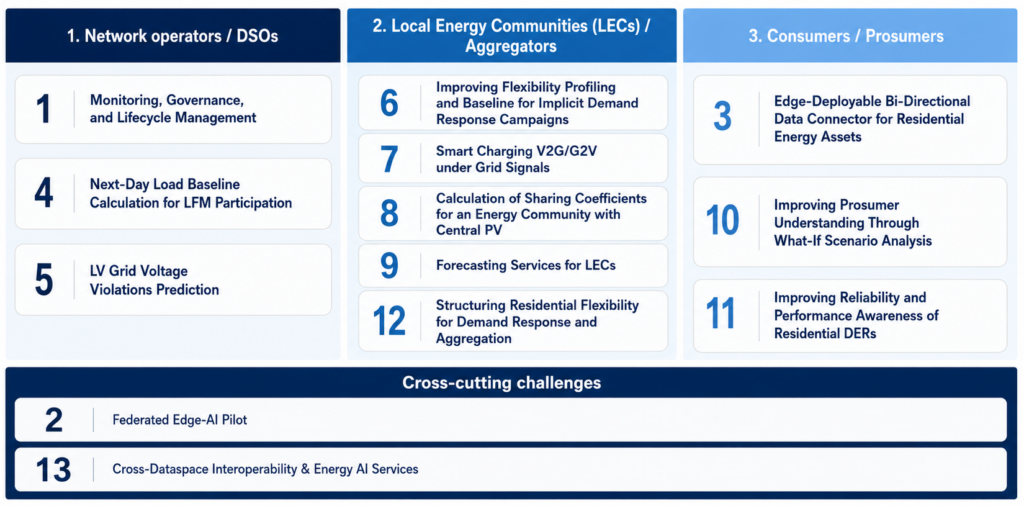
Applicants choose one of 13 defined challenges to address. Each challenge is scoped with expected results, available datasets and platform tools, and the target end-user group.
- Challenge 1 – Monitoring, Governance, and Lifecycle Management.
- Challenge 2 – Federated Edge-AI Pilot
- Challenge 3 – Edge-Deployable Bi-Directional Data Connector for Residential Energy Assets
- Challenge 4 – Next-Day Load Baseline Calculation for LFM Participation
- Challenge 5 – LV Grid Voltage Violations Prediction
- Challenge 6 – Improving Flexibility Profiling and Baseline for Implicit Demand Response Campaigns
- Challenge 7 – Smart Charging V2G/G2V under Grid Signals
- Challenge 8 – Calculation of Sharing Coefficients for an Energy Community with Central PV
- Challenge 9 – Forecasting Services for LECs
- Challenge 10 – Improving Prosumer Understanding Through What-If Scenario Analysis
- Challenge 11 – Improving Reliability and Performance Awareness of Residential DERs
- Challenge 12 – Structuring Residential Flexibility for Demand Response and Aggregation
- Challenge 13 – Cross-Dataspace Interoperability & Energy AI Services
Why Apply to ODEON Open Call?
The ODEON Open Call offers up to €60,000 per project at a 100% funding rate as a lump sum. Payments are disbursed in three tranches tied to the three stages of the support programme:
- Stage 1 – Individual Mentoring Plan & Project Design: 15% (up to €9,000), due at Month 1.
- Stage 2 – Energy Service Development: 50% (up to €30,000), due at Month 6.
- Stage 3 – User Validation & Impact Creation: 35% (up to €21,000), due at Month 10.
Who Can Apply?
Only single legal entities are eligible; consortia are not allowed. Applications are open to SMEs and startups registered as legal entities before the end date of the open call, established in any EU Member State or Horizon Europe Associated Country.
Applicants must not be linked to ODEON consortium partners or their affiliated entities, and must not be under EU restrictive measures, in financial difficulty, or subject to insolvency proceedings.
How to Apply to ODEON Open Call
Applications must be submitted through the official online platform before the deadline. The proposal must be written in English, with all mandatory sections completed. Submissions can be modified after submission, but only until the open call deadline.
Multiple submissions are allowed, with a maximum of 3 applications per entity, each addressing a different challenge. If more than one application on the same challenge is submitted, only the one submitted closest to the deadline will be considered.
Important Dates
Open Call launch: 8 April 2026
Submission deadline: 9 July 2026 at 17:00 Brussels Time
Informational webinars: 5 May 2026 and 27 May 2026 (online)
Proposal Requirements
The application must be completed in English using the online form. The mandatory sections are the following:
- Project overview/summary (maximum 300 words).
- Section 1. Excellence: detailed description of the solution and infrastructure requirements.
- Section 2. Impact: expected impact, sustainability, and outcomes.
- Section 3. Quality and Efficiency of the Implementation: work plan and timeline, team qualifications, and budget justification following the lump sum model.
- Annex I: Declaration of Honour (mandatory, to be signed).
- Annex II: SME Checklist.
- Annex III: Privacy & Ethics.
Evaluation and Selection Process
The evaluation process follows five steps:
- Initial Check – verification of basic eligibility conditions.
- In/Out Scope Screening – assessment of project scope and European dimension (Yes/No basis).
- Independent Individual Evaluation – two independent experts score each application on Excellence, Impact, and Implementation.
- Consensus Meeting – the Selection Committee decides the list of Jury Day participants.
- Jury Day – selected applicants pitch online; the Committee decides the final list of funded projects.
Finalists then undergo a formal check (company registration, financial documents, ownership structure) and sign the Sub-grant Agreement.
During the independent individual evaluation, applications are scored by two independent experts on a 0-to-5 scale across three criteria. The minimum overall score after applying weighting factors is 60 points out of 100:
- Excellence. Weighting Factor (x8), Max. Score (40), Threshold (24).
- Impact. Weighting Factor (x6), Max. Score (30), Threshold (18).
- Implementation. Weighting Factor (x6), Max. Score (30), Threshold (18).
In cases of significant scoring divergence between evaluators, a consensus group convenes; if no agreement is reached, a third evaluator is added. In the event of tied scores, the application with the highest Impact score takes priority, followed by gender balance among the team.
The selection process aims to fund at least the highest-ranked application per challenge (provided it meets the thresholds), ensuring a balanced portfolio across the 13 challenge areas.
Additional Support Beyond Funding
Beyond the financial support, selected projects enroll in a structured 10-month support programme that includes individual mentoring and project design, technical integration assistance with the ODEON platform, and real-world user validation across five European pilot sites.
This is also a significant opportunity to access a pan-European ecosystem of energy actors: including DSOs, LECs, retailers, and prosumers from Greece, Spain, France, Denmark, and Ireland. These players can serve as first customers, validation partners, or collaborators for future commercial deployments.
Final Thoughts on ODEON Open Call
The ODEON Open Call breadth of 13 challenges covers the full spectrum of the energy data value chain: from low-level grid monitoring and voltage prediction to prosumer engagement tools and cross-dataspace interoperability. Therefore, it gives a wide range of technology providers a meaningful entry point.
The call is particularly well suited for energy-focused software SMEs and startups with solutions at or near market readiness, since funded projects must validate with real end users at actual pilot sites across five European countries. The 10-month support programme with individual mentoring adds a level of structured guidance that goes beyond a simple grant, making it an attractive option for teams that want not just funding but also technical integration support and European visibility.
One important consideration for applicants is the platform dependency: solutions must be built on and integrated with the ODEON Cloud-Edge Data & Intelligence Service Platform. Organisations unfamiliar with the ODEON architecture should carefully review the Technical Guidelines before submitting, as technical fit with the platform is a core evaluation factor under the Excellence criterion.
More Information
Don’t miss the opportunity that could be the turning point of your success

Follow us on social media so you won’t miss any upcoming Info Days or Cascade Funding Opportunities

FutureProofTextiles 1st Open Call – Digital and Green Innovation for Textile SMEs