JARVIS Open Call 2: Funding for Human-Robot Interaction Innovators to Co-Develop and Pilot Advanced Robotic Solutions in Industrial Environments
Up to €100,000 per project (Co-Development Track) and up to €130,000 per project (External Pilots Track) for SMEs and SME-led consortia developing AI-enhanced human-robot interaction solutions across aeronautics, automotive, nuclear, offshore energy and other industrial sectors. The submission deadlines are 1 June 2026 (Co-Development) and 10 July 2026 (External Pilots).
About JARVIS
JARVIS is a Horizon Europe-funded research project focused on advancing Human-Robot Interaction (HRI) in industrial environments in a human-centric manner. The project develops and validates intelligent robotic solutions that support agile manufacturing and inspection and maintenance operations in complex industrial settings.
The JARVIS objectives include:
- Developing AI-enhanced means of interaction for seamless human-robot communication and control.
- Building socially interactive robots, ensuring security, privacy and safety in trustworthy AI.
- Developing cognitive and intelligent mechatronics for advanced HRI and dynamic scene understanding.
- Implementing HRI in large-scale pilots.
- Boosting companies to adopt industrial HRI solutions.
The JARVIS technology stack is being developed and validated across four industrial pilot environments: automotive manufacturing (TOFAS), aeronautics production (Collins Aerospace), nuclear decommissioning (EDF) and offshore energy operations (Equinor). The project is coordinated by LMS (Laboratory for Manufacturing Systems and Automation, Greece) with a consortium that includes TECNALIA (Spain), CEA (France), Tampere University (Finland), KUKA (Germany), Netcompany-Intrasoft, SINTEF (Norway) and Teaching Factory Competence Center (Greece), among others.
About JARVIS Open Call 2
JARVIS Open Call 2 (OC2) is the project’s second open call and allocates a total of €1,450,000 across two simultaneous and distinct tracks:
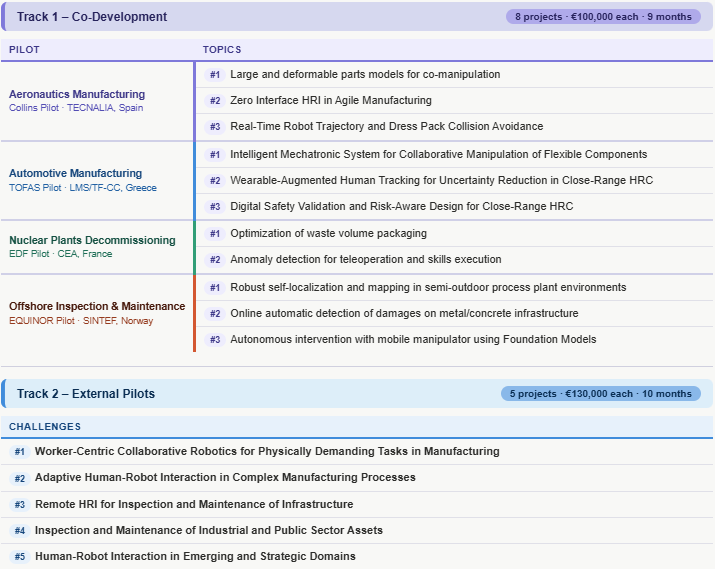
Track 1 – Co-Development (€800,000)
Targets technology developers, SMEs and start-ups, capable of designing and implementing ROS2-deployable modules or mechatronic components that extend the existing capabilities of the four JARVIS pilot testbeds. Eight projects will be funded with up to €100,000 each, over a nine-month period.
Co-Development Topics
Each pilot in Track 1 – Co-Development is hosted and mentored by a JARVIS consortium partner.
Aeronautics Manufacturing – Collins Pilot (TECNALIA, Spain) focuses on human-robot collaboration in the lay-up and assembly of composite materials for aircraft interior shells. Three topics are open:
- #1. Large and deformable parts models supporting the implementation of impedance control-based for co-manipulation.
- #2. Zero Interface Human Robot Interaction in Agile Manufacturing.
- #3. Real-Time Robot Trajectory and Dress Pack Collision Avoidance.
Automotive Manufacturing – TOFAS Pilot (LMS/TF-CC, Greece) targets human-robot collaboration in hybrid vehicle battery pack assembly. Three topics are open:
- #1. Intelligent Mechatronic System for Collaborative Manipulation of Linear Flexible Components.
- #2. Wearable-Augmented Human Tracking for Uncertainty Reduction in Close-Range HRC.
- #3. Digital Safety Validation and Risk-Aware Design for Close-Range Human–Robot Collaboration.
Nuclear Plants Decommissioning – EDF Pilot (CEA, France) applies human-robot collaboration to inspection and dismantling activities in nuclear decommissioning environments. Two topics are open:
- #1. Optimization of waste volume packaging.
- #2. Anomaly detection for teleoperation and skills execution.
Offshore Inspection and Maintenance – EQUINOR Pilot (SINTEF, Norway) deploys mobile manipulators for autonomous inspection and semi-autonomous intervention in offshore environments. Three topics are open:
- #1. Robust self-localization and mapping with mobile robots in semi-outdoor process plant environments.
- #2. Online automatic detection of damages on metal/concrete infrastructure and/or operational features.
- #3. Autonomous intervention with mobile manipulator using Foundation Models.
Track 2 – External Pilots (€650,000 total)
Targets micro-consortia composed of a technology provider and a use case provider (an industrial company that provides its own operational environment for testing). Five projects will be funded with up to €130,000 each, over a ten-month period.
All proposals in Track 2 – External Pilots must integrate exactly one JARVIS module using ROS2-compatible interfaces. The module must act as a complementary enabler.
External Pilot Challenges
- Challenge 1. Worker-Centric Collaborative Robotics for Physically Demanding Tasks in Manufacturing.
- Challenge 2. Adaptive Human-Robot Interaction in Complex Manufacturing Processes.
- Challenge 3. Remote Human-Robot Interaction for Inspection and Maintenance of Infrastructure.
- Challenge 4. Inspection and Maintenance of Industrial and Public Sector Assets.
- Challenge 5. Human-Robot Interaction in Emerging and Strategic Domains.
Why Apply to JARVIS Open Call 2?
Track 1 – Co-Development
Funding of up to €100,000 per project, disbursed in three lump-sum instalments over the nine-month programme:
| Sprint | Goal | Payment |
|---|---|---|
|
Sprint 1 (M2) |
Requirements |
20% |
|
Sprint 2 (M7) |
Development & Deployment |
60% |
|
Sprint 3 (M9) |
Integration & Validation |
20% |
Beyond funding, selected Co-Development projects receive access to JARVIS pilot testbeds, technical mentoring from consortium partners, rosbags and simulation environments, and networking within the European HRI ecosystem.
Track 2 – External Pilots
Funding of up to €130,000 per project, disbursed in three lump-sum instalments over the ten-month programme:
| Sprint | Goal | Payment |
|---|---|---|
|
Sprint 1 (M2) |
Requirements |
25% |
|
Sprint 2 (M8) |
Development & Deployment |
40% |
|
Sprint 3 (M10) |
Integration & Validation |
35% |
Selected External Pilots receive tailored mentoring for solution deployment, expert guidance for JARVIS module integration, a dedicated Innovation Mentor and an SSH Mentor (social sciences and humanities), access to the JARVIS partner network, and visibility within the European HRI innovation ecosystem.
Who Can Apply?
Track 1 – Co-Development
Applications may be submitted by individual organisations or micro-consortia of two legal entities. The consortium must be led by a technology startup or SME. An RTO may participate as optional second partner. All entities must be legally established in an EU Member State or Horizon Europe Associated Country and hold a valid VAT number.
SMEs and start-ups must have been established at least one year before submission, comply with the EU SME definition (fewer than 250 employees; annual turnover ≤€50M or balance sheet ≤€43M), and not be under bankruptcy, liquidation or financial difficulty.
Entities funded under JARVIS OC1 may apply, subject to a cumulative funding cap of €200,000 across all JARVIS open calls.
Track 2 – External Pilots
Applications must be submitted by micro-consortia of two to three legal entities. The mandatory structure requires a Lead Partner (technology startup or SME, acting as technology developer) and a Use Case Provider (industrial company owning the operational environment where the solution will be validated). A third optional partner, an additional SME, startup or RTO acting as technology integrator, may be added.
The same SME eligibility criteria, country requirements and cumulative OC1 funding cap apply as in the Co-Development Track.
How to Apply to JARVIS Open Call 2
Applications for both tracks are submitted exclusively through the F6S platform:
- Co-Development: https://www.f6s.com/jarvis-oc2-co-development/apply
- External Pilots: https://www.f6s.com/jarvis-oc2-external-pilots/apply
Proposals must strictly follow the official templates. Only one proposal per legal entity is accepted across both tracks simultaneously, an entity appearing in multiple submissions will be automatically disqualified.
Important Dates
- Call opens: 1 April 2026
- Submission deadline (Co-Development): 1 June 2026 at 17:00 CET
- Submission deadline (External Pilots): 10 July 2026 at 17:00 CET
Proposal Requirements
Both tracks require proposals to be submitted in English via the F6S platform. The required annexes at submission stage are the completed Proposal Template of its Track (1- Co-Development and 2 – External Pilots).
Additional documents different for each Track (Declaration of Honour, SME Declaration, Declaration of Financial Stability) are required at contracting stage once selected.
Track 1 – Co-Development
The proposal must address one eligible topic from the four JARVIS pilots (Collins, TOFAS, EDF or EQUINOR) and describe a ROS2-deployable module to be developed and integrated within the JARVIS testbed. Proposals must demonstrate previous technical expertise relevant to the selected topic through videos, publications, technical reports or prior project outcomes.
Track 2 – External Pilots
The proposal must address one of the five challenges and describe a core solution developed by the applicant consortium that integrates one JARVIS module. The consortium must provide evidence of the intended deployment environment (photos, videos or documentation of the use case provider premises). The applicant consortium must use their own robotic platform. User studies with at least five participants must be conducted during Sprint 3.
Evaluation and Selection Process
Both tracks follow a three-phase evaluation process: eligibility check, external independent evaluation, and online interview.
The eligibility check will consist of passing the eligibility criteria checklist. The non-eligible applicants will be informed by e-mail and no additional feedback will be given.
During the external independent evaluation, proposals are scored by two independent external evaluators on four criteria, each on a 0–5 scale with a minimum threshold of 3 points per criterion and 15/20 overall:
| Criterion | Threshold |
|---|---|
|
1. Concept & Innovation |
3/5 |
|
2. Impact |
3/5 |
|
3. Technology Implementation Approach |
3/5 |
|
4. Consortium/Applicant Team and Use of Resources |
3/5 |
Shortlisted proposals, those who have met the minimum threshold, are invited to an online interview (approx. 30–45 min). Final selection targets eight funded projects. Contract start is tentatively July 2026.
Additional Support Beyond Funding
All selected projects in both tracks receive a dedicated JARVIS Mentoring Team, consisting of an Innovation Mentor (main liaison with the consortium) and, for External Pilots, also an SSH Mentor focused on market fit, user-centric design and societal considerations. An independent Internal Evaluator monitors progress across sprints without involvement in day-to-day activities.
Final Thoughts on JARVIS Open Call 2
JARVIS Open Call 2 is structured around two complementary entry points for robotics innovators.
The Co-Development Track is oriented toward technology developers with specific technical depth in one of eleven defined topics across four industrial pilots: the scope is narrow, the integration requirements are precise, and success depends on demonstrated expertise in areas such as deformable material modelling, physiometric sensing, SLAM, or foundation model-based manipulation.
The External Pilots Track is broader in scope, covering five challenges that span most industrial HRI applications, but requires applicants to bring their own operational environment and robotic platform as the call is not a testing ground but a validation programme for solutions already at TRL4–5.
Across both tracks, ROS2 compatibility is a non-negotiable technical condition. Applicants without an existing ROS2-capable architecture will face a significant integration burden regardless of which track they apply to.
More Information
Don’t miss the opportunity that could be the turning point of your success

Follow us on social media so you won’t miss any upcoming Info Days or Cascade Funding Opportunities

FutureProofTextiles 1st Open Call – Digital and Green Innovation for Textile SMEs