
Up to €60,000 for Transport-Sector Organisations
TRUNSPORT’s first Open Call offers transport operators, infrastructure managers, technology providers, and public bodies across road, rail, air, and water up to €60,000 in lump sum grants to test and validate cybersecurity solutions against real transport-sector threats, with 21 grants available in this round.
About TRUNSPORT
TRUNSPORT is a European cybersecurity initiative that is building a next-generation Cyber Security Hub (CSH): a one-stop platform that maps and visualises transport and industrial systems so operators can understand connections, dependencies, and critical paths, and receive automated, tailored cybersecurity recommendations.
The CSH is structured around three core service modules: Preparedness Support Services (PSS) for threat and risk assessment, continuous risk monitoring, and vulnerability testing; Human Shield Strategies (HSS) for training, awareness, and human-centric defence; and Mutual Assistance Support (MAS) for cross-organisation threat intelligence sharing and coordinated incident response.
TRUNSPORT engages external organisations in validating this ecosystem precisely through two Open Calls.
About TRUNSPORT Open Call 1
Open Call 1 targets organisations operating in the NIS2 transport sectors (road, rail, air, and water) inviting them to pilot, test, and validate cybersecurity tools, technologies, and methodologies in operational or representative environments. It is the first of two sequential rounds; a future Open Call 2 will extend the same opportunity to other OT/IT-based critical infrastructure sectors beyond transport.
The call pursues five objectives: strengthening transport organisations’ cyber preparedness; building cybersecurity awareness and readiness; supporting real-life experimentation and pilot validation; stimulating collaboration; and integrating new external entities into the TRUNSPORT ecosystem to help refine and validate the CSH itself.
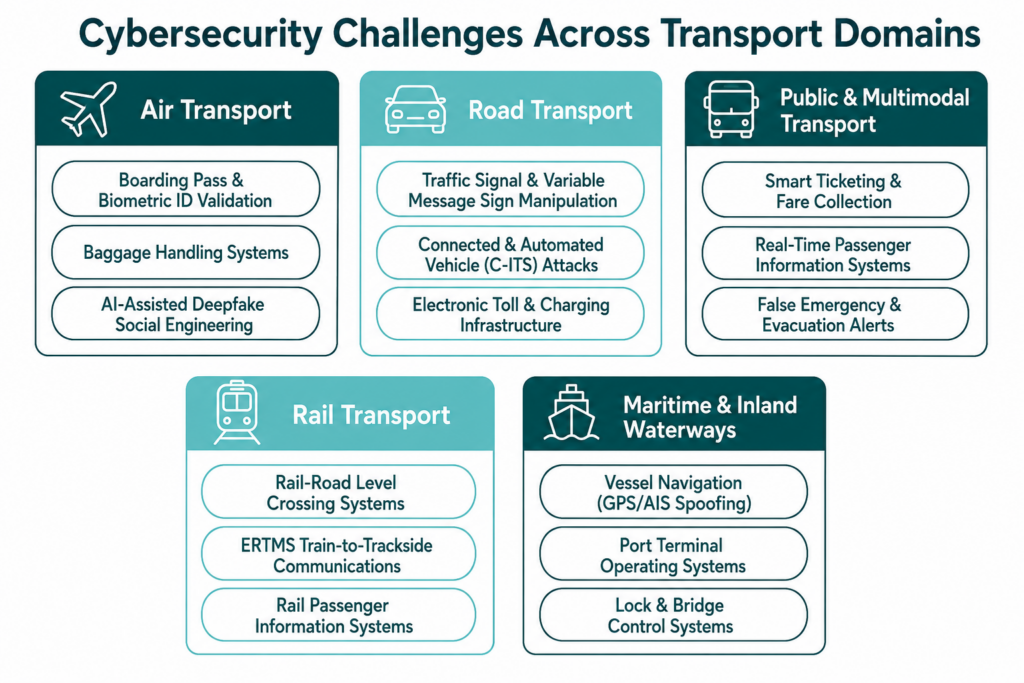
To ground these objectives, 41threat challenges across five transport domains have been established, proposals are expected to those:
- Air Transport (9) e.g. compromised boarding-pass or biometric validation systems manipulated baggage-handling controllers, or AI-generated deepfake social engineering against airport staff.
- Road Transport (15) e.g. manipulation of Variable Message Signs, traffic signal controllers, electronic tolling, or connected-vehicle (C-ITS) communications.
- Public and Multimodal Transport (4) e.g. tampering with smart ticketing systems, real-time passenger information displays, or false emergency alerts.
- Rail Transport (5) e.g. attacks on level-crossing systems, ERTMS train-to-trackside communications, or rail passenger information systems.
- Maritime and Inland Waterways (8) e.g. GPS/AIS spoofing of vessel navigation, compromised port terminal operating systems, or attacks on lock and bridge control systems.
Why apply to TRUNSPORT Open Call 1
TRUNSPORT’s budget for Open Call 1 is of €1,260,000, spread across 21 grants. The maximum grant per project is up to €60,000 (lump sum scheme), covering a maximum of 50% of total project costs; so, applicants must co-finance at least the other half.
Payments follow a three-tranche schedule tied to deliverables and project milestones: D1 – M1 (Description and Planning Report); D2 – M4 (Intermediate progress report) and D3 – M9 (Implementation and validation report.
Beyond the money, selected beneficiaries gain direct access to the TRUNSPORT Cyber Security Hub, expert mentoring, and a structured 9-month support programme.
Who can apply?
Open Call 1 is open on equal terms to a broad range of entities operating in or serving the transport sectors, including:
- Transport systems operators, transport service providers, and infrastructure managers.
- Technology and digital providers, IT solutions providers and integrators.
- SMEs and startups, including those in the ITS (Intelligent Transportation Systems) space.
- Logistics and freight transportation companies.
- Consulting companies in the transportation and cybersecurity domains.
- Universities, research organisations, and NGOs.
- Related public sector entities, organisations, and authorities.
Both single applicants and consortia may apply, and the €60,000 cap applies regardless of whether the applicant is one organisation or several partners jointly.
How to apply to TRUNSPORT Open Call 1
Applications must be submitted exclusively through the F6S platform. All documents must be in English and submitted as PDF, following the official proposal template (Arial font, minimum 9pt, A4 page size, 15mm margins). A complete application includes the Application Form, Budget Template, Declaration of Honour, Ownership Control Declaration, and — where applicable — a Consortium Declaration and SME Declaration. Only the last submitted version of an application is evaluated if multiple versions are uploaded.
Important dates
Call opens: 30 July 2026.
Deadline for clarification questions: 26 October 2026, 17:00 CET.
Application deadline: 30 October 2026, 17:00 CET.
Evaluation period: November–December 2026.
Results notification and contracting: December 2026.
Implementation start: January 2027, running for 9 months.
Proposal requirements
Funded projects must demonstrate a clear contribution to one or more of the CSH’s service modules (PSS, HSS, MAS) and be validated in an operational, simulated, virtualised, or cyber-range environment. Solutions should support RESTful APIs, common cybersecurity data standards (JSON, STIX 2.1/CACAO), and be deployable via cloud, containerised, or on-premises setups, with demonstrated compatibility with IT and/or OT infrastructures.
Beneficiaries must also participate in the kick-off meeting, project webinars, and an in-person Spotlight Demo Day in Thessaloniki to showcase their results and produce at least two of three communication outputs (a video/interview/podcast, a press release/article, or a blog post).

Evaluation and selection process
Evaluation runs in two stages. First, an administrative and eligibility check verifies completeness and compliance. Eligible proposals then move to technical evaluation by an independent panel of at least two cybersecurity experts per application.
Each proposal is scored across four equally weighted criteria, each rated from 1 to 5:
- Relevance & Objectives: alignment with the cybersecurity challenge and TRUNSPORT’s priorities.
- Team Skills & Expertise: capacity, track record, and commitment to deliver
- Excellence & Implementation: feasibility and coherence of the proposed approach
- Ambition & Impact: measurable scientific, technological, and socioeconomic impact
Proposals need a minimum score of 3/5 on every criterion and an overall minimum of 12 out of 20 points to be considered. In case of ties, criteria are compared in order (Relevance, then Team Skills, then Excellence, then Impact) to break them.
Shortlisted applicants also go through a final interview, and TRUNSPORT reserves the right to award fewer than 21 grants if the quality bar isn’t met by enough applications.
Additional support beyond funding
Selected beneficiaries receive a substantial package beyond the grant itself. This includes full access to the Cyber Support Hub; direct technical mentoring from TRUNSPORT consortium cybersecurity experts; guided NIS2 compliance evaluation; participation in realistic cross-border cyber-range exercises and penetration testing; and capacity-building webinars plus networking opportunities.
Notably, top-ranked applicants who are not selected for funding are still invited to join TRUNSPORT project activities, gaining consortium support without the financial grant.
Final thoughts on TRUNSPORT Open Call 1
TRUNSPORT Open Call 1 combines a lump-sum grant of up to €60,000 with structured technical support delivered over a fixed nine-month implementation period.
This structure is oriented toward organisations that already have a cybersecurity solution, methodology, or training programme ready to be piloted and validated in an operational, simulated, or cyber-range environment, rather than projects still at an early research stage.
Eligibility covers both individual applicants and small consortia across road, rail, air, and water transport, including NIS2 essential and important entities, SMEs, technology providers, infrastructure managers, and public sector organisations.
Given the nine-month timeline and the three fixed reporting milestones (M1, M4, M9), applicants should have the internal capacity to move directly into testing and validation activities once selected, alongside co-financing at least 50% of total project costs.
More information
Don’t miss the opportunity that could be the turning point of your success

Follow us on social media so you won’t miss any upcoming Info Days or Cascade Funding Opportunities

FutureProofTextiles 1st Open Call – Digital and Green Innovation for Textile SMEs