AI-BOOST AI Challenge Competition 3 & 4 – Generative AI for healthcare and automotive safety: Up to €100,000 per challenge for AI teams and innovators
AI-BOOST’s AI Challenge Competition is currently open for two Generative AI challenges: enhancing clinical imaging datasets with EUCAIM and automating crash-scenario test case generation with Siemens Industry Software NV. The call offers five Spark Phase winners per challenge €28,500 each, with the chance to progress to a five-month Advance Phase and compete for a final €100,000 prize, until 8 September 2026.
About AI-BOOST
AI-BOOST is an open challenge prize programme designed to serve as a benchmark for the European artificial intelligence community. Its overall objective is to create and run a highly replicable AI Challenge Competition that attracts outstanding talent from across the EU and Associated Countries to drive scientific progress in major AI domains, while fostering collaboration between key stakeholders to define challenges that lead to trustworthy, human-centric, real-world solutions. The methodology builds on the experience of earlier European open innovation programmes, including DAPSI, EDI, REACH and BLOCKCHERS.
About AI-BOOST Challenges 3 & 4
The AI Challenge Competition launches four Generative AI challenges addressing strategic industrial and societal domains, driving solutions from TRL 2–3 to TRL 4–5 through a two-phase funnel: a Spark Phase (Concept Note submission) and an Advance Phase (five-month development, validation and live demonstration). Two of the four challenges are currently open for applications:
- Challenge 3 – Generative AI for Enhancement of Clinical Datasets, led by the EUropean Federation for CAncer IMages (EUCAIM). The goal is a Generative AI solution that creates realistic synthetic patient cohorts to fill gaps in incomplete or imbalanced clinical imaging datasets, harmonising data captured under different conditions while preserving key demographic and clinical characteristics. The aim is to improve fairness, reduce bias, and support the development of trustworthy AI models for medical research and clinical decision-making.
- Challenge 4 – Generative AI for Automatic Test Case Generation from Crash Databases & Standards, led by Siemens Industry Software NV with the collaboration of EU RobustifAI. The challenge targets the validation of autonomous driving systems by transforming accident reports, visual data and international safety standards into structured, simulation-ready test scenarios, replacing slow manual processes with a scalable, consistent workflow that helps identify safety gaps and edge cases.
Why apply to AI-BOOST
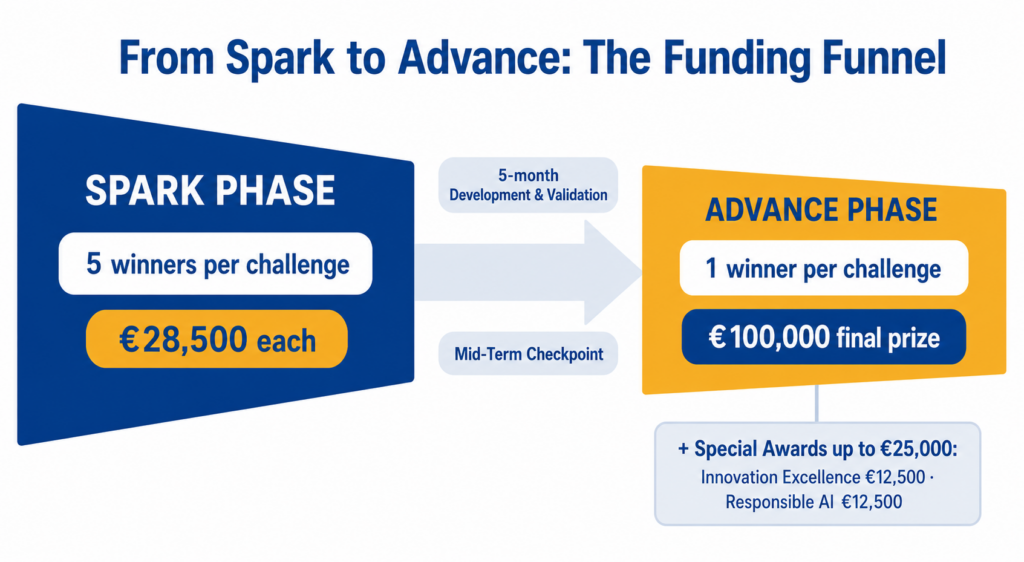
The competition offers a staged funding path: five Spark Phase winners per challenge each receive €28,500, securing a place in the Advance Phase, where one winner per challenge goes on to claim a final prize of €100,000. On top of the main prize, AI-BOOST awards two Special Awards per challenge:
- Innovation Excellence Award (€12,500).
- Responsible AI Award (€12,500).
Spark Phase prizes are paid in two instalments: 50% upon signature of the Advance Phase participation agreement, and the remaining 50% upon successfully passing the Mid-Term Checkpoint.
Who can apply?
- Individuals (students aged 18+, researchers), single legal entities, SMEs (including start-ups), and academia, universities, NGOs or non-profits — applying alone or as a consortium.
- Applicants must have technical capacity and experience working on AI systems, and proposed solutions must focus exclusively on civil applications.
- Applicants (or the legal entity, where relevant) must be established in an eligible country: the 27 EU Member States, related Overseas Countries and Territories, or an eligible Horizon Europe Associated Country (including Iceland, Israel, Norway, Turkey, Ukraine, and others listed in the Guidelines).
- No double financing: activities that have already received an EU prize or grant cannot be funded again through this competition.
- Only one proposal per applicant will be evaluated; in the event of multiple submissions, only the last one received counts, and any earlier submissions are excluded even if the final one is rejected.
- By applying, participants accept that the relevant Challenge Owner (EUCAIM or Siemens Industry Software NV) retains exclusive rights to use, test, evaluate and implement the developed solution free of charge for 6 months after the competition ends; any further commercial or licensing arrangement is negotiated separately afterward.
How to apply to AI-BOOST
Applicants register on the F6S platform, complete the full Concept Note application form, and submit before the deadline. English is the only accepted language, submissions in any other language will not be evaluated. The Concept Note form covers four blocks, plus a Declaration of Honour:
- Admin (contact and legal status details).
- Excellence (problem fit, quantifiable KPIs, innovation, TRL justification, AI technology, responsible AI/compliance, ethics and data governance).
- Impact (sustainability, social/environmental impact, fairness and diversity, exploitation plans).
- Quality of Implementation (work plan, CINECA infrastructure needs, team credentials, risk management).
Important dates
- Challenges 3 & 4 opening date: 3 July 2026
- Application deadline: 8 September 2026, 17:00 CEST (Brussels Time)
- Project start: October 2026
Proposal requirements
Winning Concept Notes must demonstrate a credible route from the applicant’s current TRL (2–3) toward the challenge’s TRL 4–5 target, backed by a realistic implementation plan covering code planning, infrastructure needs and team resources. During the Advance Phase, the five Spark winners per challenge must submit updated algorithms on a monthly basis for automatic scoring on a leaderboard, pass a mandatory Mid-Term Checkpoint (pass/fail, assessed around December 2026), and ultimately deliver a final algorithm submission, a Final Report, and a Final Pitch Presentation with live demonstration at the Brussels event.
Evaluation and selection process
Spark Phase proposals are first checked for eligibility. If more than 20 eligible applications are received for a challenge, an internal pre-assessment shortlists the top 20 using four equally weighted criteria:
- Innovation Novelty (25%)
- Challenge Fit and Motivation (25%)
- Technical Implementation Plan and Team Capacity (25%)
- Alignment with the EU AI Scene, Replicability Potential and Sustainability (25%)
Shortlisted proposals then go to external evaluation by three independent, NDA-bound experts, scored against:
- Excellence (50%): originality, soundness of the concept, data management and ethical considerations.
- Impact (25%): transformative potential, transferability, scalability, social/economic and SDG impact, sustainable AI practices.
- Quality of Implementation (25%): work plan and resources, team expertise and diversity, and capacity to reach TRL 5.
All criteria are scored on the standard Horizon Europe 0–5 scale in 0.5-point increments, from 0 (Failure) to 5 (Excellent).
Advance Phase final scoring combines four components:
- Final Report (50%), itself weighted across Technical Performance (60%), Innovation Scalability and Sector Relevance (25%), and Societal Acceptance and Responsible AI (15%)
- Final Algorithm Automatic Scoring (25%)
- Final Pitch Presentation and Live Demonstration (20%), split between Demonstration of the Solution (65%) and Communication and Presentation Quality (35%)
- Audience Vote (5%) cast live at the Brussels event
Additional support beyond funding
Participants receive continuous technical guidance and Q&A support from AI-BOOST and the Challenge Owner throughout the Advance Phase, alongside webinars and monthly leaderboard feedback benchmarking their progress against other teams in the same challenge. Those requesting access to CINECA’s LEONARDO HPC infrastructure receive dedicated onboarding covering environment configuration, SLURM job submission, Python virtual environments, data access from repositories such as Hugging Face, and monitoring tools like TensorBoard and Weights & Biases, plus guidance on scaling techniques including DDP, FSDP, DeepSpeed and Ray. The programme culminates in a Final Live Competition in Brussels, giving finalists direct visibility with evaluators, Challenge Owners and industry stakeholders.
Final thoughts on AI-BOOST Challenges 3 & 4
This call suits Generative AI teams, from individual researchers to established SMEs, with a working proof of concept at TRL 2–3 and a credible plan to reach TRL 4–5 within five months. Challenge 3 is a strong fit for teams with synthetic data generation and medical imaging expertise looking to work with a healthcare-data specialist, while Challenge 4 suits teams experienced in simulation, autonomous-vehicle safety validation, or crash data processing.
The low barrier to entry combined with staged funding, optional access to a Tier-0 supercomputer, and direct engagement with the Challenge Owner, makes this a compelling entry point for applicants who might not otherwise access this kind of computing power or domain expertise.
More information
Don’t miss the opportunity that could be the turning point of your success

Follow us on social media so you won’t miss any upcoming Info Days or Cascade Funding Opportunities
FutureProofTextiles 1st Open Call – Digital and Green Innovation for Textile SMEs